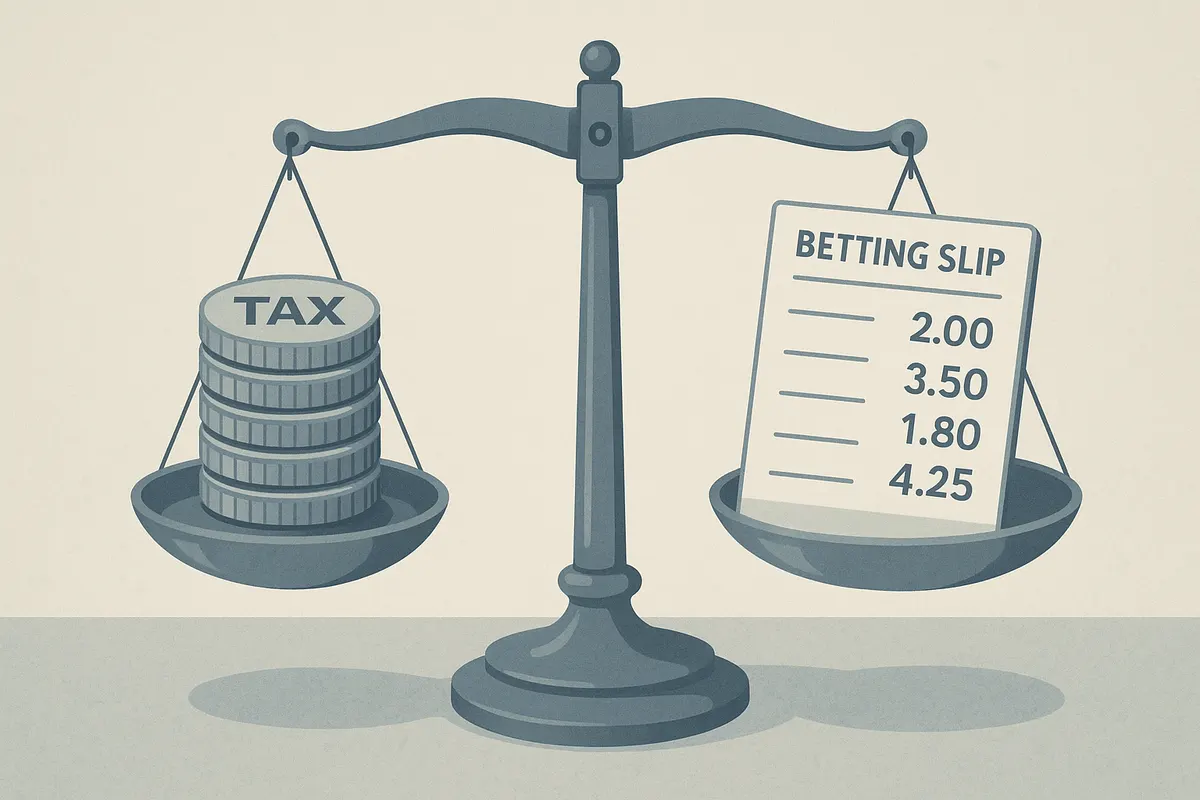
Two tabs open on a Saturday morning, same football match, same market. One book prices the home side at 1.95, the other at 1.88. Nothing about the teams has changed between those two screens. What has changed is the cost structure sitting behind each price, and tax is a real part of that cost.
That gap is the simplest way to understand gambling tax on betting. Duty is charged to operators, not usually to you at the counter, but it lands in the one number you actually interact with: the odds. Here are the questions worth asking, answered in order.
What does gambling tax on betting actually tax?
In most regulated markets, betting duty is charged on the operator’s gross gaming revenue, also called gross gambling yield: stakes taken minus winnings paid out. It is not a tax on your bet and it is not a tax on the company’s final profit. It sits in between, on the money the book keeps before it pays staff, marketing, platform fees and compliance costs.
The UK is the standard reference point. General betting duty on sports betting is charged at 15% of gross gambling yield, while remote gaming duty on online casino-style products was raised to 21% in 2019. Two different rates, two different tax bases, same underlying idea: the state takes a slice of what the operator retains.
Gross gaming revenue vs turnover
This distinction matters more than almost anything else in gambling taxation. A GGR tax scales with how much the book keeps. A turnover tax scales with how much is staked, regardless of whether the operator made money on those bets.
Run the numbers and the difference is stark. A sportsbook with a 5% gross margin that takes ₹100 in stakes keeps ₹5. A 15% GGR duty costs ₹0.75. A 5% turnover tax on the same ₹100 costs ₹5, which is the entire margin. Turnover taxes at anything but very low rates force operators to widen their prices aggressively, because there is no other lever.
Who bears the tax burden?
Legally, the operator. Economically, it is shared, and the split depends on how competitive the market is and how price-sensitive the customers are.
Some jurisdictions tax the player side directly instead. India does a bit of both: online money gaming attracts 28% GST calculated on the full value of amounts paid in rather than on operator revenue, and winnings are subject to tax deducted at source on net winnings under the income tax rules. Treat that as background information, not tax advice; the specifics of your own filings are a matter for a qualified professional.
| Tax base | What is taxed | Effect on pricing | Example |
|---|---|---|---|
| Gross gaming revenue (GGR) | Stakes minus payouts | Moderate; scales with margin | UK general betting duty, 15% of gross gambling yield |
| Turnover / amounts staked | Every rupee wagered or deposited | Heavy; forces wider margins | India’s 28% GST on the full value of online money gaming stakes |
| Player winnings | The customer’s net win | Reduces take-home value directly | TDS on net winnings under Indian income tax rules |
Why do operators oppose tax increases?
The obvious answer is that nobody enjoys paying more tax. The more interesting answer is that betting is a low-margin, high-volume business, so a few percentage points of duty move a surprising amount of the economics.
What a duty rise does to operator margins
Take a sportsbook holding a 5% gross margin on turnover. At 15% duty, roughly 4.25% of turnover survives tax. Push duty to 25% and that drops to 3.75%. That is a 12% cut to the revenue line before a single other cost is paid, and platform fees, payment processing, affiliate commissions, licensing and player protection spending all still have to come out of it.
To restore the original 4.25%, the book would need to lift its gross margin to about 5.7%. There are only three ways to find that: price bets less generously, spend less on acquiring and retaining customers, or accept lower profit. In practice, operators reach for the first two.
Regulatory and compliance expenses compound the problem. Affordability checks, anti-money-laundering systems, data reporting and licence fees are largely fixed costs that do not shrink when duty rises. Smaller operators feel this hardest, which is one reason tax increases tend to accelerate consolidation rather than spread the pain evenly.
Competitive market realities
The argument operators make loudest is about substitution. Betting is a price-driven product sold online, and a customer who dislikes 1.88 can find 1.95 in about four seconds. If licensed books widen their margins, some demand migrates to offshore sites that pay no local duty, fund no local sport, and answer to no local regulator.
That is not a reason to dismiss taxation, and the size of the leakage is genuinely disputed. But it is a real constraint on policy design, and it is why revenue forecasts from tax rises often overshoot: the tax base itself moves. Racing and lower-league sport add another layer, because betting turnover feeds into their funding through levies and media and sponsorship deals.
What happens to your odds and bonuses when betting tax rises?
The transmission from duty to player value runs through the overround, the bookmaker’s built-in edge across a market’s prices.
How the odds actually move
Consider a genuine 50/50 market. Fair odds are 2.00 on each side, implying 50% each. A competitive book might price 1.95/1.95. Each side implies 51.28% (1 ÷ 1.95), the market totals 102.56%, and the margin is about 2.5%.
Now suppose the operator needs to recover a duty increase. Shift the prices to 1.91/1.91 and each side implies 52.36%, the book totals 104.71%, and the margin roughly doubles to about 4.5%. Nothing looks dramatic on screen. The difference is only four pips of decimal odds. But on a ₹1,000 winning bet you receive ₹1,910 instead of ₹1,950, and across hundreds of bets that gap is the whole story of long-run player value.
Prices rarely move uniformly. Books protect their headline markets, where customers compare most, and take more margin on accumulators, player props, in-play and long-tail leagues where comparison is harder. If you bet mostly on niche markets, you tend to absorb more of the increase than someone who sticks to match odds on the Premier League.
Bonuses, promotions and limits
Marketing budgets are the fastest lever an operator has, and promotions are where a tax increase usually shows up first. Typical responses include:
- Smaller welcome offers, or the same headline number with stricter qualifying terms.
- Higher wagering requirements, so a free bet or bonus must be turned over more times before any balance can be withdrawn.
- Narrower game weighting and tighter maximum cashout caps on bonus play.
- Fewer price boosts, acca insurance offers and money-back specials.
- Lower maximum stake limits and quicker restriction of consistently sharp accounts.
Note the direction of travel: none of these changes are announced as a response to taxation. They arrive quietly, in updated terms and conditions. Reading the wagering requirement on an offer is the single most useful habit here, because a 100% bonus at 40× turnover is worth far less than a smaller bonus at 10×.
What the UK tax debate reveals about bookmaker taxation
The UK has spent recent budget cycles arguing about whether gambling duties should rise and whether the separate rates for betting, remote gaming and pool betting should be merged into one higher band. Think tanks have pushed for substantially higher rates on the grounds that gambling generates social costs the state ends up paying for. The industry and the racing sector have pushed back, warning about offshore leakage, job losses in retail betting shops, and reduced funding for horse racing.
Strip away the lobbying and the case study teaches three things about bookmaker taxation.
First, the shape of the tax matters as much as the headline rate. Harmonising a 15% betting duty upward toward a gaming rate treats two products with very different margin profiles as if they were the same business, which is precisely why operators resist it.
Second, tax incidence is negotiated in the market, not set in the legislation. Where competition is fierce, more of the burden stays with the operator. Where a market is concentrated or customers are loyal to one app, more of it lands on the player through worse prices.
Third, the optics run against the industry in a way the economics do not resolve. Arguing that a tax on gambling will make gambling more expensive for gamblers is not a sympathetic message, however true it is. That asymmetry is why these fights are usually settled politically rather than arithmetically.
What this means for you as a bettor
You cannot control duty rates, but you can see their effects. Compare prices across licensed operators on the same selection, because a persistent four-pip gap is real money. Read bonus terms before opting in, especially wagering requirements and maximum cashout. And be sceptical of any offer that gets bigger while the underlying odds get worse; the value has simply moved from one pocket to another.
The maths behind all of this does not change with tax policy. Every betting market carries an overround and every casino game carries a house edge, which means the operator holds a long-run advantage regardless of the duty rate. Bet only what you can comfortably lose, use deposit and loss limits, and treat betting as paid entertainment rather than income. If it stops feeling like entertainment, self-exclusion and cool-off tools exist for exactly that reason.