First, kill the myth: G2E is not a slot machine show any more
The old assumption about the Global Gaming Expo is that you walk the floor, look at new cabinets, listen to some jackpot chimes, and go home. That has not been the real story for a while, and it definitely isn’t the story in 2026. The casino gaming technology trends dominating this year’s agenda are software, data and legal structure: prediction markets, artificial intelligence, and the plumbing that connects online and land based play.
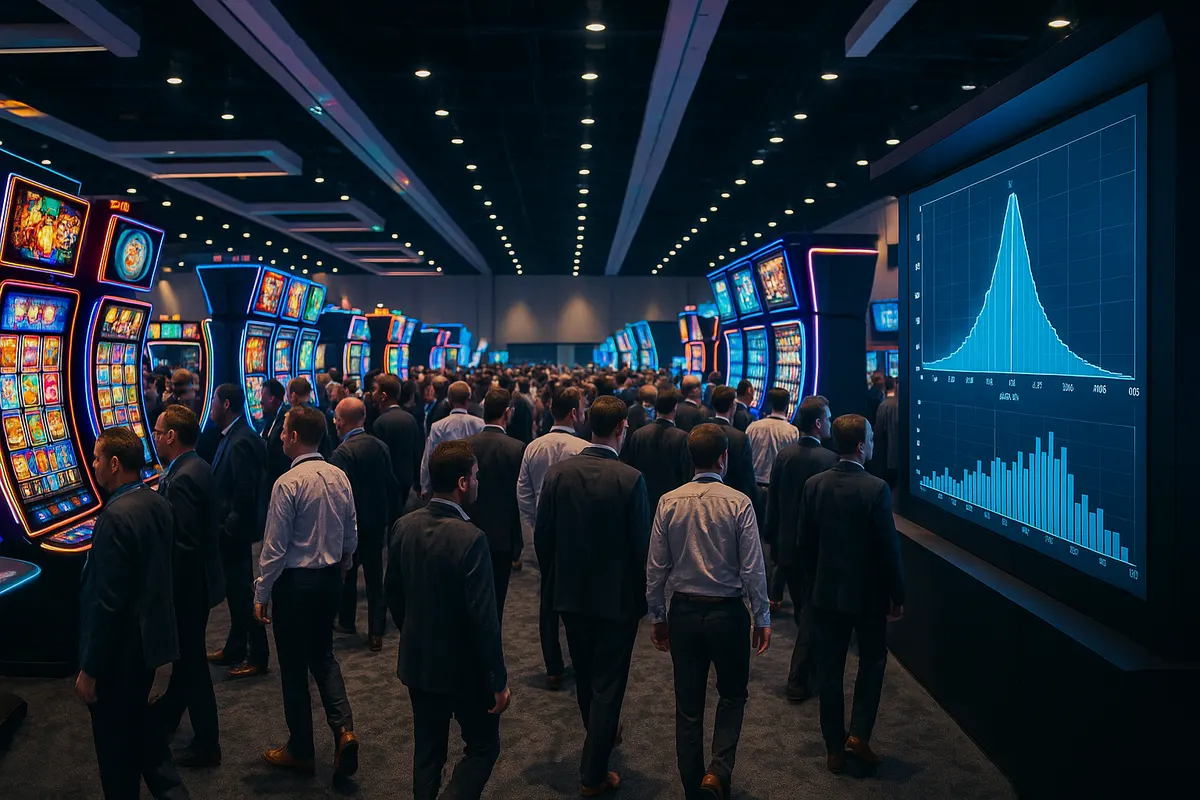
G2E 2026 runs from September 28 to October 1 at The Venetian Expo in Las Vegas, presented by the American Gaming Association and organised by RX. Organisers expect more than 25,000 gaming professionals and more than 400 exhibitors, with attendees from over 120 countries, regions and territories. Education sessions opened Monday; the exhibition floor opened Tuesday at 10 a.m. The categories on show span casino gaming, iGaming, sports betting, payments, hospitality and business technology.
Three themes carry the conversation this year, and they’re worth separating clearly because they operate on completely different timescales.
What are the main technology trends featured at G2E 2026?
Short answer: prediction markets (a regulatory and product fight happening right now), AI tooling across player analytics, security and responsible gambling (already deployed, quietly), and a longer tail of newer gaming technology such as VR/AR, blockchain rails and mobile-first live dealer formats (real, but slower).
The first is a business-model argument. The second is an operations story. The third is a product roadmap. Conference marketing tends to blend them into one “future of gaming” pitch, which is exactly how operators end up buying the wrong thing.
What are prediction markets in gambling, and why is everyone tense about them?
A prediction market lets people trade contracts on whether a future event happens. The price of the contract reflects the crowd’s estimated probability of that outcome. Buy a contract at 40 cents and, if the event settles “yes,” it pays out at $1; if it settles “no,” it’s worth nothing. The price is the implied probability, the same arithmetic that sits behind decimal odds (a 2.00 price implies 50%).
How prediction markets work compared with a bet
The practical difference is who you’re up against. In a casino game or against a sportsbook, the operator is your counterparty and its margin is baked into the price or the game math. A slot at 96% RTP carries a 4% house edge; a sportsbook builds an overround into its lines. On an exchange-style prediction market, you’re matched against other participants and the venue typically earns fees or spread rather than a price edge. That doesn’t make it a soft game. Fees, liquidity gaps and settlement rules all cost you, and most participants still lose money over time.
| Feature | Prediction market contract | Sportsbook bet | Casino game (slot/table) |
|---|---|---|---|
| What you hold | A tradable contract on an outcome | A fixed-price bet at settled odds | A wager on a single round’s result |
| Who sets the price | Other participants’ orders | The operator’s odds compiler and model | Fixed paytable and RNG maths |
| Counterparty | Other traders, via the venue | The bookmaker | The house |
| Where the venue earns | Fees / spread | Overround built into odds | House edge (100% − RTP) |
| Exit before the result | Usually yes, by selling the position | Only if cash-out is offered | No |
| Typical oversight (US) | Federal derivatives framework | State gaming regulators | State or tribal gaming regulators |
Who is driving the conversation at G2E 2026
Notably, not the operators themselves in every case. Kalshi, one of the largest prediction-market operators in the United States, is not exhibiting at G2E, yet its business model shapes the discussion across the show. The regulatory dispute is on the Main Stage: a session titled “The Power of Unity: Confronting the Prediction Markets Challenge” brings tribal gaming representatives together to discuss prediction markets, jurisdiction and the potential effect on tribal gaming.
That framing tells you who feels exposed. Licensed casinos and tribal operators pay for licences, compliance staff, responsible gambling programmes and, in many jurisdictions, gaming taxes. A venue offering event contracts under a different legal regime competes for the same attention without carrying the same obligations.
Where the regulation stands
The sharpest friction is in Nevada, where regulators have argued that prediction-market operators are effectively offering sports betting without complying with the state’s gaming framework. The core question is whether an event contract is a derivative, supervised federally, or a sports bet, supervised by the state. Until courts and legislators settle it, operators weighing a prediction-market product are making a legal bet as much as a commercial one. For anyone building a roadmap: treat this as unresolved, not as a green light.
How does AI actually work in casinos today?
Less glamorously than the marketing suggests, and more usefully. AI in casinos mostly means machine learning models applied to three jobs: understanding players, catching bad actors, and flagging harm. The models sit behind existing systems rather than replacing games.
Player analytics and personalisation
Operators already hold enormous behavioural datasets: session lengths, game preferences, bet sizes, deposit patterns, churn signals. Machine learning turns that into segmentation and recommendation, so a player who only touches live dealer blackjack stops getting pushed slot promotions. On the floor side, the same analytics inform machine placement, denomination mix and staffing. It’s a merchandising engine, not magic.
One correction worth making, because it circulates constantly: certified RNG outcomes are not personalised. A licensed game’s random number generator and paytable are tested and locked; no AI layer adjusts your spin results because you’ve been losing. What can be personalised is what you’re shown, which offers you receive and how the lobby is ordered. Those are marketing decisions, and they’re exactly why deposit limits are worth setting before you need them.
Security, fraud and payments
This is where AI earns its budget quickest. Anomaly detection models are good at spotting bonus abuse rings, multi-accounting, card-testing patterns, collusion at online tables and mismatches between KYC data and device fingerprints. Paired with fintech integration on the payments side, the same scoring runs in real time on deposits and withdrawals, which is why accounts occasionally freeze mid-cashout for verification. Irritating for honest players, effective against organised fraud.
Responsible gambling tools
Behavioural models can flag markers of harm well before a human notices: escalating deposit frequency, chasing losses after a downswing, overnight sessions, cancelled withdrawals. Regulators in several markets now expect this kind of monitoring, and the interesting technical question is what happens after the flag fires. A model that produces a risk score and triggers nothing is compliance theatre. Automated interventions, hard limits, cool-off prompts and human outreach are what make the score matter. If you’re a player, you don’t need to wait for the algorithm: deposit limits, loss limits, reality checks and self-exclusion are available on any licensed site.
Which other new gaming technologies are worth your attention?
Virtual and augmented reality
VR casino products keep appearing at trade shows and keep failing to find scale. The demos are genuinely impressive and the friction is real: headsets are a barrier, sessions are short, and the social element that VR promises is precisely what live dealer streams already deliver on a phone. AR has a more plausible near-term use inside physical properties, such as wayfinding and overlays on the casino floor, rather than as a gaming format.
Blockchain and provably fair mechanics
Blockchain’s practical value in regulated gaming is currently in settlement, auditability and provably fair verification, where cryptographic seeds let a player check that a round’s outcome wasn’t manipulated. That’s a real trust feature, most visible in crash-style games. It does not change the maths: a provably fair game still carries a house edge. Verification proves fairness of process, not favourable odds.
Mobile and live dealer advances
The least hyped category is the one actually shifting revenue. Better streaming compression, vertical-format live dealer tables, lower-latency studios and game shows built for a five-inch screen have done more for engagement in the last few years than any headset. Expect continued convergence: land based cabinets with account-linked mobile wallets, cashless play, and the same title running across retail and online.
What will these technologies actually change for players and operators?
Split it by how fast each moves. Fraud and analytics tooling is already live at most large operators and will keep improving invisibly. Responsible gambling automation follows regulatory deadlines, so the pace is set by legislators, not vendors. Cashless and mobile-linked play spreads property by property as jurisdictions approve it. Prediction markets could change the competitive map fast or barely at all, depending entirely on how the Nevada dispute and federal questions resolve. VR stays a demo category for now.
For operators, the honest takeaway from G2E 2026 is that the differentiators are compliance-adjacent: verification speed, payment reliability, harm detection that works, and a legal position you can defend. For players, the visible changes are smaller and duller than the keynote language suggests, which is fine. Faster withdrawals, fewer irrelevant promotions, cleaner mobile live dealer tables and better limit tools are worth more than a headset.
And the constant behind all of it: the technology doesn’t alter the arithmetic. RTP, house edge and market margins still mean the operator or venue wins over time. Treat gambling as paid entertainment, set a budget you can lose, and use the limit tools that all this AI is busy building. If it stops being fun, self-exclusion exists for a reason.
Full programme and exhibitor details are published by Global Gaming Expo.