Does banning online betting actually stop people betting?
Brazil just ran the experiment in public, and the early numbers point one way: no. Within days of Provisional Measure No. 1.394/2026 ending the country’s regulated fixed-odds betting and online casino market, monitoring data showed the betting ban illegal market expanding at roughly ten times its previous pace. The demand stayed exactly where it was. Only the supply changed, and it changed for the worse.
This piece looks at what the data actually says, then works through the assumptions that usually surround a ban and where each one falls apart. If you bet in a market with its own patchwork of prohibitions, including India, the mechanics here are worth understanding.
Brazil’s betting ban and the illegal market surge, by the numbers
The monitoring platform Bet Legal identified 428 new illegal betting sites between the ban announcement and Sunday, 27 September, which works out to about 143 new domains per day. That is the headline figure, but the build-up is just as revealing. Between 21 and 24 September, while President Luiz Inácio Lula da Silva was publicly threatening a ban but had not yet signed anything, 246 new illegal sites appeared, around 62 per day. The baseline, recorded by industry association ANJL between June and August, was 13.7 new illegal domains per day.
So the illegal supply chain started scaling up on the threat, then accelerated on the signature.
| Period | New illegal betting domains | Daily average |
|---|---|---|
| June to August 2026 (baseline, ANJL) | — | 13.7 per day |
| 21–24 September (ban threatened) | 246 | ~62 per day |
| Announcement to 27 September (ban signed) | 428 | ~143 per day |
Context matters here. Before the ban, LCA Consultores estimated illegal operators already held 38% to 44% of the Brazilian market, and in a survey of 2,291 bettors, 77% said they had used a platform involved in illegal practices. The black market gambling problem was not created by the ban. The ban removed its only competitor.
Myth: prohibition removes the demand
Demand doesn’t disappear, it relocates
Betting demand is fairly inelastic in the short run. People who were placing weekly wagers on football did not lose interest because a legal instrument was signed in Brasília. What a ban changes is the cost of access, and in online gambling that cost is close to trivial. A mirror domain, a Telegram channel, a payment link. No shopfront to close, no border to cross.
Compare that with a physical prohibition, where supply genuinely gets harder to build. Online, the marginal cost of spinning up another unlicensed site is small enough that 143 of them can appear in a single day. Operators had every incentive to move first, because a ban hands them a market with no licensed alternative and no compliance overhead.
The players most at risk move first
There is an uncomfortable behavioural layer to this. The players least likely to stop when access is restricted are the ones betting compulsively, because their play is driven by habit and chasing rather than by convenience. Those players are precisely the ones the regulated market’s safeguards were built around.
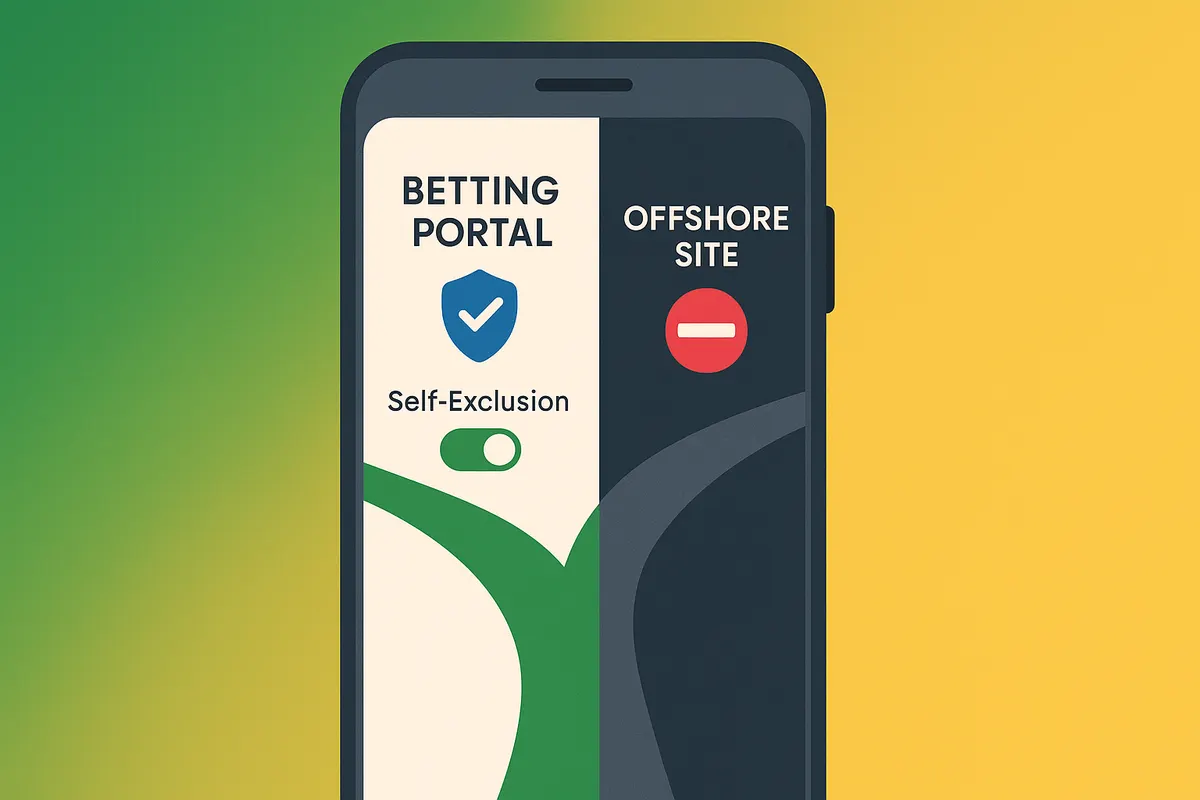
And in Brazil those safeguards went with the ban. The regulated framework required facial biometrics, blocked minors, banned credit-card funding, mandated self-exclusion and deposit limits, and applied daily blocking for Bolsa Família and BPC social benefit recipients. None of that applies to an unlicensed site. The protection layer was switched off at the same moment demand was pushed underground.
Myth: an unlicensed site is just a legal site without the paperwork
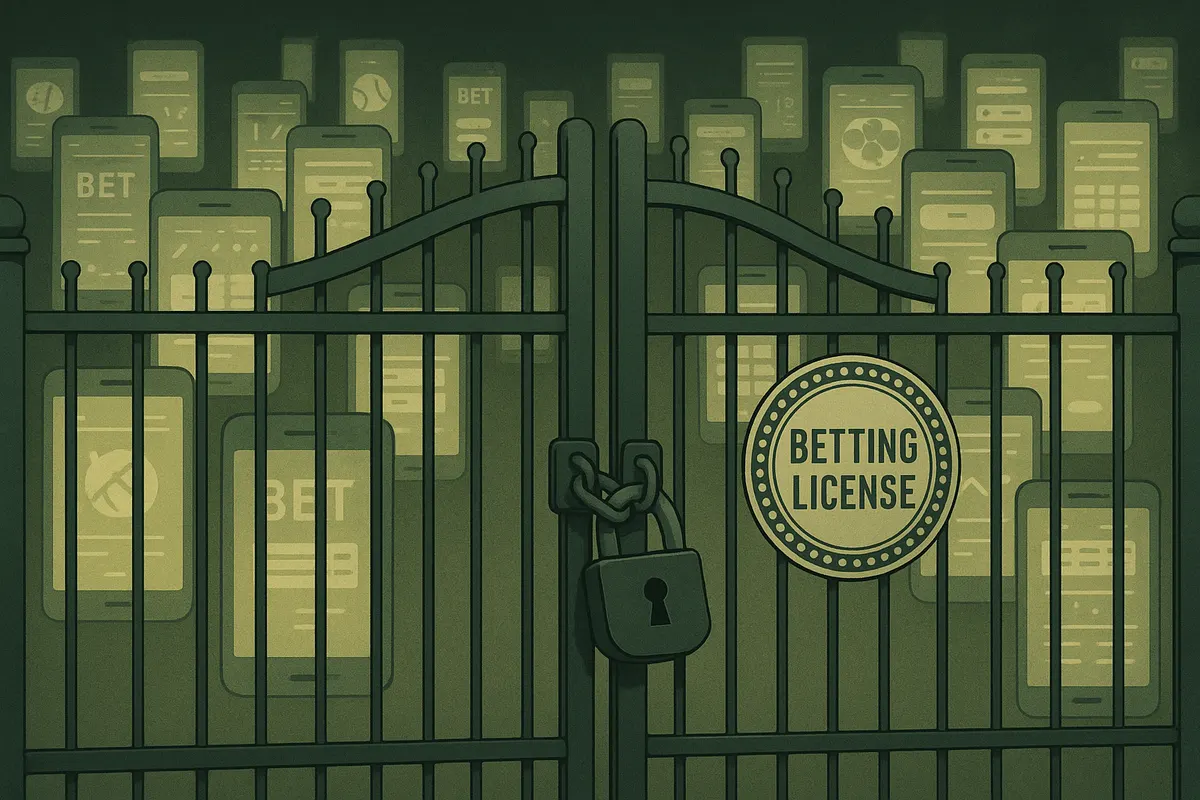
The licence is not paperwork. It is the mechanism that makes every other promise on the site enforceable. Remove it and the risks stack up in three directions.
Financial risk
On a licensed platform, game outcomes come from tested RNG software, RTP figures are audited, and player funds are usually subject to segregation rules. An unlicensed operator publishes whatever RTP it likes and answers to nobody if the maths does not match. Withdrawals are where this usually surfaces: a deposit clears instantly, then the cashout stalls behind a new verification demand, a “bonus irregularity”, or a support address that stops replying. Unlicensed sites also lean on enormous bonus offers with wagering requirements so steep that the balance is mathematically very hard to release, sometimes 50x or more on the bonus with heavy game weighting restrictions buried in the terms.
Security and data risk
You hand an unlicensed operator your ID document, a selfie, bank details and often UPI or card credentials, with no data protection obligation on the other side and no regulator to complain to if that database is sold or breached. Payment handling is often routed through intermediaries and shifting merchant accounts, which is how players end up with declined transactions, unexplained charges, or a bank flagging their account for activity they cannot easily explain.
No recourse, and a tax mess
Disputes are the clearest difference. A licensed operator sits under a complaints process with a regulator behind it. With an offshore, unlicensed site, there is no appeal above the operator’s own support desk. Winnings are still taxable income in most jurisdictions, including India, but an illegal platform issues no statements and withholds nothing, leaving the player to reconstruct and report everything themselves. An unpaid balance plus an unreported liability is a bad combination.
Myth: you can spot an illegal betting site at a glance
Increasingly you cannot. The good ones clone licensed sites down to the payment icons. Work through checks instead of impressions.
- Find the licence number and verify it at the source. A footer badge is just an image. Take the licence number to the regulator’s own public register and confirm the company name matches the site you are on.
- Read the terms for the company behind the brand. A registered corporate name and address should appear. Vague wording, or a jurisdiction that does not license online gambling at all, is a hard stop.
- Check the responsible gambling tools. Deposit limits, session limits, reality checks, cool-off and self-exclusion should be present and actually functional in the account settings. Illegal operators rarely bother, because these features reduce revenue.
- Treat implausible bonuses as a warning, not an opportunity. 500% welcome offers and “no wagering” claims paired with unreadable terms usually mean the balance exists to keep you playing, not to be withdrawn.
- Look at the payment methods. Personal-account transfers, crypto only, a rotating list of unnamed processors, or instructions to label a deposit as something else all point to a platform working around the banking system.
- Search the withdrawal complaints, not the reviews. Independent player forums tell you more in ten minutes than any affiliate ranking page.
- Test the support desk before you deposit. Ask a specific question about withdrawal limits and verification. Evasive or copy-paste answers tell you what the cashout experience will be.
Myth: enforcement will catch up with the black market
Brazil’s own figures argue otherwise. The Prizes and Betting Secretariat has four employees dedicated to oversight, covering nearly 200 authorised websites plus thousands of illegal operators. Of the R$1 million allocated in 2026 for betting and lottery regulation and supervision, R$275,600 had been used. A supervisory body of that size was already stretched policing a licensed market. Asked to police an entirely illegal one, it is arithmetic that does not work.
The fiscal side compounds it. The proposed 2027 Budget counted on R$5.3 billion (roughly $1 billion) in betting-related revenue, money the state collects only from operators that exist legally.
What Brazil’s experience tells other regulators
The lesson is not that gambling harm is imaginary or that regulation should be light. It is that regulation only protects players while a legal, more convenient option exists for them to choose. Licensing gives a state leverage: age verification, credit-card bans, deposit caps, self-exclusion registers, advertising limits, audited game maths, tax visibility. Prohibition trades all of that leverage for a prohibition it cannot enforce.
Where a market genuinely wants to shrink gambling activity, the tools that survive contact with reality tend to be the boring ones applied to licensed operators: tighter affordability checks, real deposit limits, restrictions on advertising and bonus aggression, payment blocking with bank cooperation, and enforcement funded at a scale that matches the number of sites it has to monitor. Four inspectors and a quarter-spent budget is not an enforcement strategy.
Indian readers are watching a version of this play out at home, between state-level prohibitions, the national move against real-money online games, and a large offshore sector that never applied for permission in the first place. The takeaway for a player is practical rather than political: the safety you get does not come from the law existing, it comes from the specific platform you use being accountable to someone. Verify the licence yourself, understand the bonus terms before you accept them, and use deposit and session limits while you still have the option.
Frequently asked questions
Why do betting bans increase illegal gambling?
Because they remove supply without removing demand. Online betting is cheap to relaunch under a new domain, so unlicensed operators fill the gap almost immediately, as Brazil’s jump from 13.7 to about 143 new illegal domains per day showed. Players keep the habit and simply switch to whoever is still taking bets.
What happens when a country bans online betting?
Typically three things at once: licensed operators exit, unlicensed sites multiply, and the state loses both tax revenue and its regulatory safeguards. In Brazil’s case, age checks, credit-card restrictions, deposit limits and self-exclusion stopped applying because they only ever bound licensed companies.
How can I tell if a betting site is illegal?
Verify the licence number on the regulator’s public register rather than trusting a footer badge, look for a named registered company in the terms, and check that deposit limits and self-exclusion tools genuinely work. Outsized bonuses, informal payment channels and unresolved withdrawal complaints are the common tells.
Gambling carries a built-in house edge, which means losses over time are the mathematical expectation, not bad luck. Bet only money you can afford to lose, set deposit and session limits, and if it stops feeling optional, use self-exclusion tools or contact a local support service. Content here is educational and not legal or tax advice.